
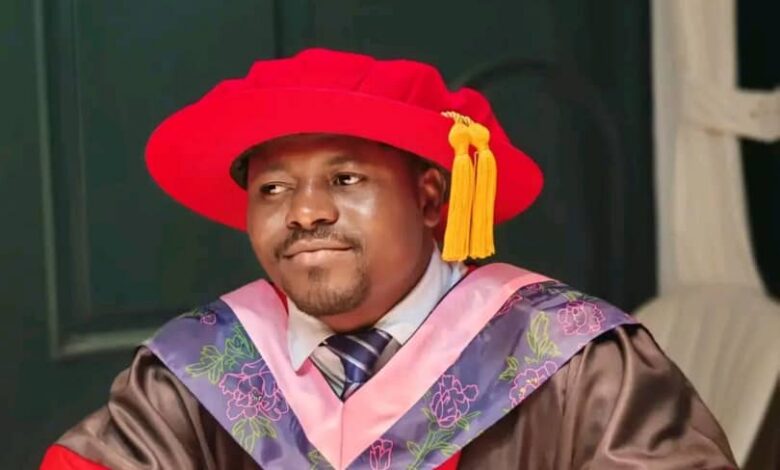
Dr Maguacher Jérémie : « The results of my research highlight that higher education is a key tool for building a more prosperous, resilient, and self-reliant Africa. »
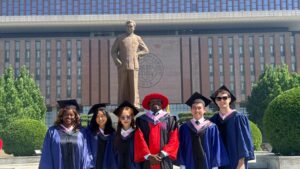
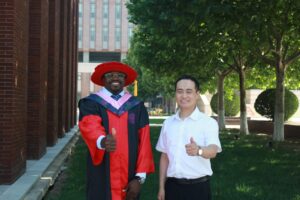
Graduating with a PhD from Tianjin University (Institute for Global South Studies), which he successfully defended in 2026, young Cameroonian Jérémie Maguacher spoke with Actu Chine-Cameroun. In this exclusive interview, he talks about his research topic, the main findings of his work, and his vision for a more thriving Africa, while also sharing his perspective on China, which hosted him during his years of study.
- What is the theme of your research? Why did you choose it ?
My doctoral thesis topic is: “On the Sustainable Development Strategies of China–Cameroon Higher Education Cooperation.”
Since the 2024 Beijing Summit of the Forum on China–Africa Cooperation, Sino–Cameroon higher education cooperation has evolved into a comprehensive strategic domain and has become a key mechanism through which diplomatic commitments can be transformed into long-term development value. For Cameroon, the current stage of cooperation requires the establishment of a new conceptual framework, namely, one that no longer treats higher education cooperation as a secondary component of external relations but rather positions it as a strategic asset capable of driving local development. In this context, the present study systematically examines the strategic role of Sino–Cameroon higher education cooperation in advancing sustainable development, with particular emphasis on evaluating its contributions to the United Nations Sustainable Development Goals (SDGs), Cameroon Vision 2035, and the National Development Strategy 2020–2030, as well as the pathways through which these contributions are realized. This study is grounded in a positivist paradigm and integrates the Internationalization of Higher Education Theory, Strategic Management Theory, and Sustainable Development Theory to construct a “development-oriented internationalization” analytical framework.
2. What results did you obtain ? Can you provide a brief summary ?
The empirical findings indicate that participants generally hold positive perceptions of Sino–Cameroon higher education cooperation, considering it credible, relevant, and developmentally valuable. The overall quality of cooperation received a very high evaluation (average = 4.51), while its strategic contribution to Cameroon’s Vision 2035 was also strongly recognized (average = 4.38). Furthermore, respondents considered the partnership effective in advancing national development agendas (average = 4.07). Particularly noteworthy is the high level of recognition of the partnership’s contributions to SDG 4 (Quality Education) and SDG 9 (Industry, Innovation, and Infrastructure), with approval rates of 91.5% and 81.7%, respectively. In addition, scholarships, mobility programs, curriculum internationalization, and platforms such as joint laboratories and research centers were assigned significant importance in promoting applied research development (average range = 4.15–4.21). Cultural and social exchange dimensions also received positive feedback: 92.4% of respondents reported that cooperation has strengthened intercultural understanding, and the Confucius Institute was widely regarded as an important facilitator of cultural exchange. Nevertheless, the study also identifies multiple structural challenges facing the partnership. These challenges include inadequate policy coordination (86.2%), limited transparency in funding mechanisms (81.5%), insufficient institutional capacity building on the Cameroonian side (80.0%), low stakeholder participation (78.5%), weak monitoring and evaluation systems (23.1%), fragmented governance structures, and a mismatch between training outputs and labor market demands. Across the evaluated dimensions, governance transparency and efficiency (M = 2.51), resource allocation (M = 2.78), and institutional resource sufficiency (M = 2.83) received significantly lower scores. From a theoretical perspective, Sino–Cameroon higher education cooperation can be conceptualized as a strategic internationalization process fundamentally oriented toward sustainable development. The study demonstrates that the partnership has achieved its strongest outcomes in mobility, scholarship support, curriculum internationalization, and intercultural understanding. However, its long-term transformative impact depends much more on the optimization of governance structures, the realization of shared institutional ownership, and the localized absorption and re-innovation of knowledge and skills. Although cooperation demonstrates strong alignment with Cameroon’s national strategies, the global sustainable development agenda, and broader China–Africa cooperation frameworks at the policy level, significant gaps remain at the operational and implementation levels. Consequently, the central constraint of current cooperation does not lie in the willingness to cooperate or the scale of cooperation itself, but rather in how cooperative activities can be effectively transformed into sustainable local institutional capacity, knowledge absorption, and innovation capability. Ultimately, the future success of Sino–Cameroon higher education cooperation depends on a strategic transition from a “project-driven and mobility- centered” model toward a “strategically guided, evidence-based, and nationally integrated” partnership paradigm. Based on these findings, the study proposes a governance framework and implementation roadmap that combine strategic foresight with operational feasibility for policymakers and relevant government entities.
- How can the results of your research help Cameroon in particular and Africa in general in their development efforts?
For Cameroon, the study provides a practical and strategic roadmap for aligning international higher education partnerships with national development priorities, particularly those outlined in Vision 2035 and the National Development Strategy (NDS 2020–2030). One of the study’s major contributions is the development of several strategic frameworks and policy instruments to strengthen the long-term sustainability and effectiveness of China–Cameroon higher education cooperation. These include the SDG Mission Cluster Map for China–Cameroon Higher Education Cooperation (2026–2035), the National Development Education Cooperation Blueprint (NDECB), the Internationalization Compact for Sino–Cameroon Higher Education Cooperation, the UMa–ZJNU Transnational Education Partnership Model, and a proposed Joint Sino–Cameroon Vocational University Management System. Together, these frameworks constitute a comprehensive policy blueprint that can assist policymakers, universities, and development partners in transforming educational cooperation into a strategic instrument for sustainable development. Furthermore, the implementation of these recommendations can help improve the quality and relevance of higher education, strengthen research and innovation ecosystems, facilitate technology transfer, enhance university-industry-government collaboration, and develop a highly skilled workforce capable of responding to the evolving demands of the economy. Furthermore, the study offers practical solutions to address youth unemployment, improve graduate employability, and accelerate Cameroon’s industrial, agricultural, and digital transformation.
At the African level, the study provides valuable insights into how higher education can catalyze capacity building, knowledge production, innovation, and sustainable development. The findings contribute to ongoing discussions surrounding the African Union’s Agenda 2063, the Sustainable Development Goals (SDGs), and Africa’s aspirations to build competitive, knowledge-based economies. More importantly, the research advocates a shift from traditional aid-based approaches toward strategic partnerships founded on shared learning, institutional resilience, co-creation of knowledge, and long-term developmental impact. In this regard, the study offers a replicable model for other African countries seeking to strengthen international educational cooperation while preserving national priorities and ownership. It demonstrates how higher education can become a strategic pillar for economic growth, technological innovation, social progress, and sustainable development across the African continent. Ultimately, the research highlights higher education as a key instrument for building a more prosperous, resilient, and self-reliant Africa.
- How did the defense go overall? What were the most valuable comments from the jury?
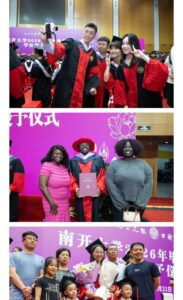
The defense went very well and was conducted in a constructive and intellectually stimulating atmosphere. The jury appreciated the dedication and the originality of the work and its relevance to contemporary China–Cameroon relations, and the strategic and policy-oriented nature of the recommendations.The jury also noticed that I have incorporated a diplomatic meeting style, with a Cameroon-China flag in the meeting room, which was directly relevant to the topic and to the environment itself. The expert appreciated the work and recommended that I continue researching and contributing to the development of China-Cameroon ties, and in the future align my research with the building of a community of shared future, so that both countries can properly have a common knowledge foundation toward this common development.
- China has helped you significantly so far. What are your views on Chinese society, the reception you received from the Chinese people, the Chinese education system, and Sino–Cameroonian cooperation, particularly in education ?
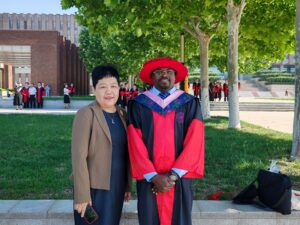
My experience in China has been extremely positive and transformative. I have been deeply impressed by the hospitality, kindness, and openness of the Chinese people. Throughout my academic journey, I received tremendous support from professors, especially from Chen Bateer and Ru Ning; from Zhou Enlai School of Government Dean Wu Xiaolin; School of International Education Dean Wang Hongchang, and other university administrators, classmates, and friends who contributed significantly to my personal and professional development. The Chinese education system is particularly remarkable for its emphasis on academic excellence, research, innovation, discipline, and practical problem-solving. Chinese universities have created an environment that encourages international collaboration and technological advancement. I was especially impressed by the integration of AI, industry, and national development priorities. Regarding Sino–Cameroonian cooperation, I believe that education represents one of the most successful dimensions of the bilateral ties. Through scholarships, university partnerships, vocational training programs, and research cooperation, China has contributed significantly to the development of human capital in Cameroon. Moving forward, the partnership should focus even more on joint research, technology transfer, innovation, and the co-creation of solutions that address Africa’s development challenges.
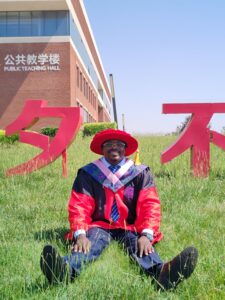
- Now that you have obtained this degree, what are your future plans? Do you intend to put the scientific knowledge acquired in China at the service of your country ?
Absolutely. Obtaining this doctoral degree is not the end of my academic journey but rather the beginning of a new phase of service and contribution. My primary objective is to use the knowledge, skills, and experience acquired in China to contribute to the development of Cameroon and Africa. I intend to continue conducting research on higher education and sustainable development, international development, and global governance. I also hope to contribute to policy formulation, university development, research capacity building, and the strengthening of international academic partnerships. In the future, I aspire to work closely with government institutions, university leaders, international organizations, and development partners to promote evidence-based policies that support education, innovation, and national development. I strongly believe that the knowledge gained in China should be translated into practical solutions that improve lives, strengthen institutions, and advance Cameroon and the African continent. Ultimately, my goal is to serve as a bridge between China and Africa, fostering mutual understanding and shared development for future generations.


 Français
 简体中文
简体中文 English